Nasa Declare Pulto a Planet Again
A squad of scientists wants Pluto classified every bit a planet once again — along with dozens of similar bodies in the solar organisation and any found effectually distant stars.
The call goes confronting a controversial resolution from 2006 by the International Astronomical Union that decided Pluto is only a "dwarf planet" — simply the researchers say a rethink will put science back on the correct path.
Pluto had been considered the ninth planet since its discovery in 1930, simply the IAU — which names astronomical objects — decided in 2006 that a planet must be spherical, orbit the sun and accept gravitationally "cleared" its orbit of other objects.
Pluto meets ii of those requirements — it'south round and it orbits the lord's day. But considering it shares its orbit with objects chosen "plutinos" it didn't qualify under the new definition.
As a result, the IAU resolved the solar organization only had eight major planets — Mercury, Venus, Earth, Mars, Jupiter, Saturn, Uranus and Neptune — and Pluto was relegated from the list.
Simply a study announced in December from a team of researchers in the periodical Icarus now claims the IAU'south definition was based on astrology — a blazon of folklore, not science — and that it's harming both scientific inquiry and the popular understanding of the solar system.
The researchers say Pluto should instead be classified as a planet under a definition used past scientists since the 16th century: that "planets" are any geologically active bodies in infinite.
Likewise as Pluto, that definition includes many other objects — the asteroid Ceres, for example, and the moons Europa, Enceladus and Titan. Merely the researchers say the more the merrier.
"We call back at that place'due south probably over 150 planets in our solar system," said Philip Metzger, the study's lead author and a planetary physicist at the University of Central Florida.
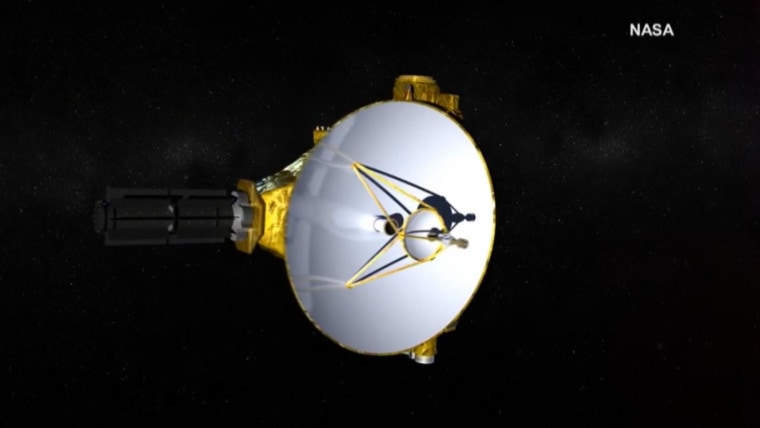
The study comes amid research based on data from NASA's New Horizons probe, which flew by Pluto in 2015.
The probe's revelations have revived fence well-nigh Pluto'south status, planetary geologist Paul Byrne of Due north Carolina Land University said.
"In that location was such involvement from the New Horizons flyby," said Byrne, who was not involved in the written report. "But every time I gave a talk and I put up a picture of Pluto, the first question was not well-nigh the planet'due south geology, but why was information technology demoted? That'due south what stuck with people, and that's a existent shame."
The researchers fence the IAU definition contradicted a definition of a planet that had stood for centuries.
Objects like to Pluto, such as Eris and Makemake, had been institute past 2006, and and so the IAU engineered its definition to exclude them, Metzger said.
That led to the IAU — and therefore the public — adopting the "astrological" concept that Globe and the other planets were few and special, instead of a better classification that would have profoundly increased the number of planets, he said.
The effect is that about planetary scientists now condone the IAU's definition, he said.
"We are continuing to call Pluto a planet in our papers, we are standing to call Titan and Triton and another moons past the term 'planet'," he said. "Basically, we are ignoring the IAU."
The definition has gained new importance as meliorate techniques and telescopes — such as the James Webb infinite telescope — will discover more than "exoplanets" around afar stars.
Metzger said most star systems are not like ours. Instead of a handful of planets orbiting at large distances, they often take a few very large planets, perhaps orbited by large moons, circling very shut to their star.
That means whatsoever definition based on our solar system won't be relevant to most of the others.
"Because of the diversity of planetary architectures that nosotros're discovering, we call back information technology's important to become it right at this time," Metzger said.
But it seems in that location is no impetus in the IAU to change its definition, and the campaign to brand Pluto a planet over again is not welcomed by champions of the 2006 resolution.
Caltech astronomer Michael Brown, the author of the memoir "How I Killed Pluto and Why It Had It Coming," says the IAU made the right telephone call by correctly classifying it as a dwarf planet.
"I think the IAU stock-still an embarrassing mistake that had been perpetuated for generations," he said in an email. "The solar system is at present sensible."
Jean-Luc Margot, a professor and astronomer at the University of California, Los Angeles, added in an email that the IAU definition aids the study of exoplanets by correctly classifying them, considering it would unremarkably be impossible to determine if an exoplanet was geologically active or not.
Another recent study looks at a curious feature seen in the New Horizons photographs — the polygonal patches visible on Pluto's surface.
Pb author Adrien Morison, a physicist at the University of Exeter in the United Kingdom, said the polygons are caused by the sublimation — the procedure of melting directly from a solid to a gas — of nitrogen ice. The ice left cools and becomes denser than before, and and so it sinks and is replaced past water ice from below. The result is a mural that'due south been likened to a "lava lamp."
"The boundaries of the polygons are where the cold ice goes down, while the center of the polygons are where the hotter ice from below goes up," he said in an email.
The polygons show Pluto is changing from low-temperature geological processes. Simply explanations are needed for other features, such every bit its mountains and surface faults, he said. "We still know very footling about all the processes that could continue there."
Both Morison and Byrne hold the IAU classification has had a scientific impact, and recollect Pluto and similar bodies should be classified as planets.
But "it's not particularly crucial whether the IAU agrees," Morison said. "It doesn't foreclose us, as scientists, from using a more than convenient definition for our purposes."
Source: https://www.nbcnews.com/science/space/pluto-planet-debate-rages-rcna8848
0 Response to "Nasa Declare Pulto a Planet Again"
Post a Comment