What German Art Movement Affected Haydn Writing What Does the Term Mean
Sturm und Drang (,[1] High german: [ˈʃtʊʁm ʔʊnt ˈdʁaŋ]; usually translated equally "storm and stress"[ii]) was a proto-Romantic movement in German literature and music that occurred between the tardily 1760s and early 1780s. Within the movement, individual subjectivity and, in detail, extremes of emotion were given complimentary expression in reaction to the perceived constraints of rationalism imposed by the Enlightenment and associated aesthetic movements. The period is named after Friedrich Maximilian Klinger'south play of the same proper name, which was first performed past Abel Seyler's famed theatrical company in 1777.
The philosopher Johann Georg Hamann is considered to be the ideologue of Sturm und Drang; other pregnant figures were Johann Anton Leisewitz, Jakob Michael Reinhold Lenz, H. L. Wagner, and Friedrich Maximilian Klinger. Johann Wolfgang von Goethe and Friedrich Schiller were notable proponents of the movement early in their lives, although they ended their catamenia of clan with it by initiating what would become Weimar Classicism.
History [edit]
Counter-Enlightenment [edit]
French neoclassicism (including French neoclassical theatre), a movement beginning in the early on Baroque, with its emphasis on the rational, was the principal target of rebellion for adherents of the Sturm und Drang movement. For them, sentimentality and an objective view of life gave mode to emotional turbulence and individuality, and enlightenment ideals such as rationalism, empiricism, and universalism no longer captured the human condition; emotional extremes and subjectivity became the vogue during the late 18th century.
Etymology [edit]

The term Sturm und Drang commencement appeared every bit the title of a play by Friedrich Maximilian Klinger, written for Abel Seyler's Seylersche Schauspiel-Gesellschaft and published in 1776.[iii] The setting of the play is the unfolding American Revolution, in which the writer gives violent expression to hard emotions and extols individuality and subjectivity over the prevailing gild of rationalism. Though it is argued that literature and music associated with Sturm und Drang predate this seminal work, information technology was from this point that German artists became distinctly self-conscious of a new artful. This seemingly spontaneous motion became associated with a wide array of German authors and composers of the mid-to-late Classical period.[4]
Sturm und Drang came to exist associated with literature or music aimed at shocking the audition or imbuing them with extremes of emotion. The movement before long gave way to Weimar Classicism and early Romanticism, whereupon a socio-political concern for greater human freedom from despotism was incorporated along with a religious treatment of all things natural.[5]
There is much debate regarding whose work should or should non be included in the canon of Sturm und Drang. Ane point of view would limit the move to Goethe, Johann Gottfried Herder, Jakob Michael Reinhold Lenz, and their direct German associates writing works of fiction and/or philosophy between 1770 and the early on 1780s.[6] The alternative perspective is that of a literary motion inextricably linked to simultaneous developments in prose, verse, and drama, extending its direct influence throughout the German-speaking lands until the end of the 18th century. Nevertheless, the originators of the movement came to view it every bit a time of premature exuberance that was then abased in favor of often conflicting artistic pursuits.[7]
Related artful and philosophical movements [edit]
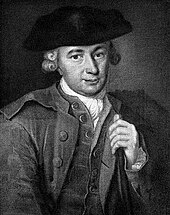
As a forerunner to Sturm und Drang, the literary topos of the Kraftmensch existed amid dramatists beginning with F.Thou. Klinger. Its expression is seen in the radical degree to which individuality need appeal to no exterior potency save the self nor be tempered past rationalism.[8] These ideals are identical to those of Sturm und Drang, and it can be argued that the afterwards proper noun exists to catalog a number of parallel, co-influential movements in German language literature rather than express anything substantially different from what German dramatists were achieving in the trigger-happy plays attributed to the Kraftmensch movement.
Major philosophical/theoretical influences on the literary Sturm und Drang movement were Johann Georg Hamann (especially the 1762 text Aesthetica in nuce. Eine Rhapsodie in kabbalistischer Prose) and Johann Gottfried Herder, both from Königsberg, and both formerly in contact with Immanuel Kant. Pregnant theoretical statements of Sturm und Drang aesthetics past the motility's central dramatists themselves include Lenz' Anmerkungen übers Theater and Goethe's Von deutscher Baukunst and Zum Schäkespears Tag (sic). The nigh important contemporary document was the 1773 volume Von deutscher Art und Kunst. Einige fliegende Blätter, a collection of essays that included commentaries by Herder on Ossian and Shakespeare, forth with contributions by Goethe, Paolo Frisi (in translation from the Italian), and Justus Möser.
In literature [edit]
Characteristics [edit]
The protagonist in a typical Sturm und Drang stage work, poem, or novel is driven to activity—ofttimes tearing action—not by pursuit of noble means nor past true motives, but by revenge and greed. Goethe's unfinished Prometheus exemplifies this along with the common ambiguity provided past juxtaposing humanistic platitudes with outbursts of irrationality.[nine] The literature of Sturm und Drang features an anti-aristocratic slant while seeking to elevate all things humble, natural, or intensely real (peculiarly whatsoever is painful, tormenting, or frightening).
The story of hopeless love and eventual suicide presented in Goethe'due south sentimental novel Die Leiden des jungen Werthers (1774) is an instance of the author'due south tempered introspection regarding his dear and torment. Friedrich Schiller's drama, Die Räuber (1781), provided the groundwork for melodrama to become a recognized dramatic course. The plot portrays a disharmonize betwixt two aristocratic brothers, Franz and Karl Moor. Franz is cast every bit a villain attempting to cheat Karl out of his inheritance, though the motives for his action are complex and initiate a thorough investigation of good and evil. Both of these works are seminal examples of Sturm und Drang in German literature.
The absence or exclusion of women writers from accounts of Sturm und Drang can be taken as a consequence of the movement'southward and the menses'southward masculinist ethos or as a failure of more contempo literary criticism to engage with literary works by women--such equally Marianne Ehrmann--that might merit inclusion.[10]
Notable literary works [edit]
- Johann Wolfgang von Goethe (1749–1832):
- Zum Shakespears Tag (1771)
- Sesenheimer Lieder (1770–1771)
- Prometheus (1772–1774)
- Götz von Berlichingen (1773)
- Clavigo (1774)
- Die Leiden des jungen Werthers (1774)
- Mahomets Gesang (1774)
- Adler und Taube (1774)
- An Schwager Kronos (1774)
- Gedichte der Straßburger und Frankfurter Zeit (1775)
- Stella. Ein Schauspiel für Liebende (1776)
- Die Geschwister (1776)
- Friedrich Schiller (1759–1805):
- Dice Räuber (1781)
- Die Verschwörung des Fiesko zu Genua (1783)
- Kabale und Liebe (1784)
- An dice Freude (1785)
- Jakob Michael Reinhold Lenz (1751–1792)
- Anmerkung über das Theater nebst angehängtem übersetzten Stück Shakespeares (1774)
- Der Hofmeister oder Vorteile der Privaterziehung (1774)
- Lustspiele nach dem Plautus fürs deutsche Theater (1774)
- Dice Soldaten (1776)
- Friedrich Maximilian Klinger (1752–1831):
- Das leidende Weib (1775)
- Sturm und Drang (1776)
- Die Zwillinge (1776)
- Simsone Grisaldo (1776)
- Gottfried August Bürger (1747–1794):
- Lenore (1773)
- Gedichte (1778)
- Wunderbare Reisen zu Wasser und zu Lande, Feldzüge und lustige Abenteuer des Freiherren von Münchhausen (1786)
- Heinrich Wilhelm von Gerstenberg (1737–1823):
- Gedichte eines Skalden (1766)
- Briefe über Merkwürdigkeiten der Literatur (1766–67)
- Ugolino (1768)
- Johann Georg Hamann (1730–1788):
- Sokratische Denkwürdigkeiten für die lange Weile des Publikums zusammengetragen von einem Liebhaber der langen Weile (1759)
- Kreuzzüge des Philologen (1762)
- Johann Jakob Wilhelm Heinse (1746–1803):
- Ardinghello und die glückseligen Inseln (1787)
- Johann Gottfried Herder (1744–1803):
- Fragmente über die neuere deutsche Literatur (1767–1768)
- Kritische Wälder oder Betrachtungen, die Wissenschaft und Kunst des Schönen betreffend, nach Maßgabe neuerer Schriften (1769)
- Journal meiner Reise im Jahre (1769)
- Abhandlung über den Ursprung der Sprache (1770)
- Von deutscher Art und Kunst, einige fliegende Blätter (1773)
- Volkslieder (1778–79)
- Vom Geist der Hebräischen Poesie (1782–1783)
- Ideen zur Philosophie der Geschichte der Menschheit (1784–1791)
In music [edit]
The Classical period music (1750–1800) associated with Sturm und Drang is predominantly written in a minor key to convey difficult or depressing sentiments. The primary themes tend to be angular, with large leaps and unpredictable melodic contours. Tempos and dynamics change quickly and unpredictably in social club to reverberate strong changes of emotion. Pulsing rhythms and syncopation are common, every bit are racing lines in the soprano or alto registers. Writing for cord instruments features tremolo and sudden, dramatic dynamic changes and accents.
History [edit]
Musical theater became the meeting place of the literary and musical strands of Sturm und Drang, with the aim of increasing emotional expression in opera. The obligato recitative is a prime example. Here, orchestral accompaniment provides an intense underlay of vivid tone-painting to the solo recitative. Christoph Willibald Gluck's 1761 ballet, Don Juan, heralded the emergence of Sturm und Drang in music; the program notes explicitly indicated that the D pocket-sized finale was to evoke fearfulness in the listener. Jean Jacques Rousseau'due south 1762 play, Pygmalion (showtime performed in 1770) is a similarly important bridge in its utilize of underlying instrumental music to convey the mood of the spoken drama. The first example of melodrama, Pygmalion influenced Goethe and other important German literary figures.[11]
However, relative to the influence of Sturm und Drang on literature, the influence on musical composition was limited, and many efforts to label music as conforming to this trend are tenuous at all-time. Vienna, the eye of High german/Austrian music, was a cosmopolitan city with an international civilisation; therefore, melodically innovative and expressive works in minor keys by Haydn or Mozart from this menstruation should generally be considered first in the broader context of musical developments taking place throughout Europe. The clearest musical connections to the self-styled Sturm und Drang movement can exist found in opera and the early on predecessors of program music, such as Haydn's Cheerio Symphony. Beethoven, Weber, and even Schubert have elements of Sturm und Drang.
Haydn [edit]
A Sturm und Drang period is oft attributed to the works of the Austrian composer Joseph Haydn from the late 1760s to early 1770s. Works during this period ofttimes feature a newly impassioned or agitated element; all the same, Haydn never mentions Sturm und Drang as a motivation for his new compositional style,[12] and there remains an overarching adherence to classical class and motivic unity. Though Haydn may not take been consciously affirming the anti-rational ideals of Sturm und Drang, one tin certainly perceive the influence of contemporary trends in musical theatre on his instrumental works during this menstruation.
Mozart [edit]
Mozart's Symphony No. 25 (the "Little" Chiliad-minor symphony, 1773) is one of only two minor-primal symphonies by the composer. Across the singular primal, the symphony features rhythmic syncopation forth with the jagged themes associated with Sturm und Drang.[thirteen] More interesting is the emancipation of the air current instruments in this slice, with the violins yielding to colorful bursts from the oboe and flute. All the same, it is likely the influence of numerous minor-central works by the Czech composer Johann Baptist Wanhal (a Viennese gimmicky and acquaintance of Mozart), rather than a self-conscious adherence to a German literary movement, which is responsible for the harmonic and melodic experiments in the Symphony no. 25.[fourteen]
Notable composers and works [edit]
- Carl Philipp Emanuel Bach
- Symphonies, keyboard concertos and sonatas including Symphony in E small Wq. 178 (1757–62)
- Johann Christian Bach
- Symphony in G minor Op. six No. 6
- Johann Christoph Friedrich Bach
- Oratorio Die Auferweckung des Lazarus
- Cantata Cassandra
- Wilhelm Friedemann Bach
- Adagio und Fuge in D minor Falk 65
- Joseph Haydn
- Symphony No. 39 in G minor Tempesta di mare (1767)
- Symphony No. 49 in F minor La Passione (1768)
- Symphony No. 26 in D minor Lamentatione (1769)
- Symphony No. 59 in A major Feuer (Burn down) (1769)
- Symphony No. 44 in E small-scale Trauer (Mourning) (1772)
- Symphony No. 45 in F sharp small Adieu (1772)
- Symphony No. 46 in B major (1772)
- Symphony No. 52 in C minor (1771)
- Cord Quartet No. 11 in D minor, Op. 9 No. iv (1769)
- String Quartet No. nineteen in C modest, Op. 17 No. iv (1771)
- Cord Quartet No. 26 in G minor, Op. twenty No. 3 (1772)
- String Quartet No. 23 in F minor, Op. 20 No. 5 (1772)
- Piano Sonata Hob. Sixteen/47 in E minor (1765-67)
- Piano Sonata Hob. XVI/twenty in C minor (1771)
- Pianoforte Sonata Hob. Xvi/44 in G minor (1771-73)
- Piano Sonata Hob. Xvi/32 in B minor (1774-76)
- Joseph Martin Kraus
- Symphony in C modest Symphonie funebre
- Symphony in C-sharp minor
- Wolfgang Amadeus Mozart
- Symphony No. 25 in G minor, K. 183 (1773)
- String Quartet No. 13 in D pocket-sized, Yard. 173 (1773)
- Violin Sonata No. 21 in Due east minor, K. 304 (1778)
- Piano Sonata No. viii in A small-scale, Chiliad. 310 (1778)
- Johann Gottfried Müthel
- Works for keyboard
- Johann Baptist Wanhal
- Symphony in D small-scale (Bryan d1)
- Symphony in G minor (Bryan g1)
- Symphony in A pocket-sized (Bryan a2)
- Symphony in E small-scale (Bryan e1)
- Ernst Wilhelm Wolf
- Works for keyboard
In visual art [edit]
The parallel movement in the visual arts tin can be witnessed in paintings of storms and shipwrecks showing the terror and irrational destruction wrought by nature. These pre-romantic works were stylish in Deutschland from the 1760s on through the 1780s, illustrating a public audition for emotionally provocative artwork. Additionally, disturbing visions and portrayals of nightmares were gaining an audience in Germany as evidenced by Goethe's possession and admiration of paintings by Fuseli capable of "giving the viewer a good fearfulness."[15] Notable artists included Joseph Vernet, Caspar Wolf, Philip James de Loutherbourg, and Henry Fuseli.
In theatre [edit]
The Sturm und Drang motion did not last long; co-ordinate to Betty Waterhouse it began in 1771 and ended in 1778 (Waterhouse v). The ascent of the eye grade in the 18th century led to a modify in the way society and social standings were looked at. Dramatists and writers saw the stage equally a venue for critique and word of societal issues. French writer Louis-Sébastien Mercier suggested that drama be used to promote political ideas, a concept that would develop many years later. After the Seven Years' War, which ended in 1763, High german spirit was extremely high and Germans felt a sense of importance on a grander stage. The elite gained power equally the ruling class, furthering the divide and increasing tensions betwixt the classes (Liedner viii). With these new ideals came the sense that a new form of art capable of dethroning the extremely popular French neoclassicism was needed. Johann Georg Hamann, a noted German philosopher and a major promoter of the Sturm und Drang motility, "dedicated the native culture of the Volk and maintained that language, the root of all our experience, was richer in images and more powerful prior to the 'abstract' eighteenth century" (Liedner eight). Deutschland did non accept a mutual state entity; instead, the nation was broken into hundreds of small states. The Sturm und Drang movement was a reaction to this lack of political unity for the German people and frequently dealt with the idea of living life on a smaller scale and the want to become a function of something bigger.
The Sturm und Drang movement likewise paid a lot of attention to the language of a slice of literature. It is no wonder that Shakespeare, with his brilliant use of language, originality with circuitous plot lines and subplots, and multifaceted characters from all social classes, was seen as a model for German writers (Wilson and Goldfarb 287). Many writers of the Sturm und Drang movement considered themselves to exist challengers of the Enlightenment. All the same, the motion is really a continuation of the Enlightenment. Many Sturm und Drang plays showed interest in how society affects the individual, a common theme in many Enlightenment plays likewise. However, Sturm und Drang "makes its own distinctive contribution to 18th-century civilization, bringing attention to the power of the surroundings as well as to the contradictory and self-defeating attitudes present in every segment of society" (Liedner ix). Far before its time, the divergent way of Sturm und Drang shrewdly explored depression and violence with an open up plot construction (Liedner ix). The Sturm und Drang movement rebelled against all the rules of neoclassicism and the enlightenment, outset recognized Shakespeare equally a "genius" of dramaturgy, and provided the foundation for 19th-century romanticism. Writers such as Heinrich Leopold Wagner, Goethe, Lenz, Klinger, and Schiller used episodic structure, violence, and mixed genres to annotate on societal rules and morals, while doubting that anything would alter. The Sturm und Drang movement was brief, but it set a fire that still burns intensely today.
Six primary playwrights initiated and popularized the Sturm und Drang movement: Leisewitz, Wagner, Goethe, Lenz, Klinger, and Schiller. The theatre director Abel Seyler, the owner of the Seylersche Schauspiel-Gesellschaft, had an important role in promoting the Sturm und Drang poets.
Johann Anton Leisewitz [edit]

Johann Anton Leisewitz was born in Hanover in 1752 and studied law. He is remembered for his single complete play, Julius of Taranto (1776), which is considered the forerunner of Schiller's work The Robbers (1781).[16] He was married to Sophie Seyler, the girl of theatre director Abel Seyler.
Wagner [edit]
Heinrich Leopold Wagner was born in Strasbourg on February xix, 1747. He studied law and was a member of the literary group surrounding Johann Daniel Salzmann. He was a dramatist, producer, translator, and lawyer for the traveling Abel Seyler theatre company. Wagner was all-time known for his two plays, Die Reue nach der Tat ("The Remorse After the Deed") in 1775 and Die Kindermorderin ("The Childmurderess") in 1776. Kid murder was a very popular topic in the 18th century and all of the major Sturm und Drang writers used it as a subject in their writings (Waterhouse 97). Dice Kindermorderin was ane of the virtually traditional plays of the Sturm und Drang. Although sharing aspects of neoclassical plays, such as a fairly unproblematic plot and very few changes in the setting, it breaks away from the neoclassical idea that the protagonist must exist of noble descent. Instead, this play shows how the aristocracy disrupts the lives of middle class characters (Liedner xii). This play also uses a vast array of colorful language to demonstrate the variety of characters and their social statuses. Some other common theme seen in Die Kindermorderin is the idea of society hindering change. Groningseck, a lieutenant, seems to be willing to expect by social norms and pause down walls between the classes, but a boyfriend officeholder, Hasenpoth, betrays him (Liedner xii).
Goethe [edit]
Johann Wolfgang von Goethe was born in August 1749, in the Free Royal Urban center of Frankfurt, Holy Roman Empire. He wrote his first of import play, Goetz von Berlichingen in 1773, in Shakespearean style, a defining feature of the Sturm und Drang movement (Wilson and Goldfarb 287). Shakespeare was considered a genius among High german playwrights, and was idolized for his "shattering of the dramatic unities of time, place and action; and his sharply individualized, emotionally circuitous characters" (Waterhouse v). Goethe was well known for his staging equally well equally his long dramatic poem Faust (Goethe's Faust) (Wilson and Goldfarb 287). Goethe was the director of theatre at the Weimar Theatre where he eventually ran the unabridged company. He went to Italy for two years to collect himself and while there discovered the beauty of the Greek and Roman ruins. After this trip he returned with involvement in classical ideas and writing, and a new class of writing emerged called Weimar Classicism.
Lenz [edit]
Jakob Michael Reinhold Lenz was born in Sesswegen, now Latvia, on the January 23, 1751. He studied theology and philosophy at the University of Konigsberg. His commencement poem, Die Landplagen ("Torments of the Land"), emerged in 1769. He went on to write "Notes on the Theatre", The New Menoza and Der Hofmeister ("The Tutor") in 1774, Pandemonium Germanicum in 1775, and Die Soldaten ("The Soldiers") in 1776 (Liedner 11). Lenz took Aristotle'southward popular idea of plot being more important than graphic symbol and reversed it, equally well as reclassified the distinctions between comedy and tragedy. In Lenz'south works, tragedies feature characters that brand decisions that crusade events, and in comedies a resolute milieu pushes and pulls the character through events (Liedner xi). The Soldiers is nearly likely Lenz'due south most singled-out case of Sturm und Drang literature. It centers on an idea of degradation of civilians by soldiers, but more than specifically the seduction and abuse of young women by soldiers. Illustrating an undesirable, conflicted character with no power over her situation who does whatever she can to get through her current state, The Soldiers displays a "well-observed world where one'southward identity is fluid – and hopelessly entangled in the social and linguistic environment" (Liedner xi). This idea of feeling unable to change 1's situation is typical of many Sturm und Drang plays. Lenz'south use of reserved dialogue, open form, violence, and a combination of one-act and tragedy precursors the works of contemporary authors such equally Friedrich Dürrenmatt and Bertolt Brecht (Waterhouse v).
Klinger [edit]
Friedrich Maximilian Klinger was built-in in Frankfurt on February 17, 1752. He was born into a humble family and struggled financially after the death of his father. He studied law at Giessen with the financial assistance of Goethe's family unit. He also worked with the Abel Seyler troupe for a twelvemonth and a half (Pascal 132). Although famous for his Sturm und Drang style plays, many of his earlier plays were very classical in manner. Some of Klinger's works include Die Zwillinge (1776), Die neue Arria (1776), Simsone Grisaldo (1776), and Stilpo und seine Kinder (1780). Klinger'southward most famous play, Sturm und Drang (1776), is the seminal slice of literature associated with the Sturm und Drang epoch. Strangely, the play is set in revolutionary America, not Germany. We come across allusions to Shakespeare'south Romeo and Juliet through the feuds of the households, as well as All'due south Well That Ends Well in some of the grapheme's names (Liedner xiii). Klinger utilized a defining characteristic of Sturm und Drang when he mixed aspects of comedy and tragedy throughout the play, stating " the deepest tragic emotion continually alternates with laughter and joviality" (Liedner xiii).
Schiller [edit]
Friedrich Schiller was born in Marbach on November x, 1759. He studied medicine at Karlsschule Stuttgart, a prestigious military machine university founded by the Duke of Württemberg. He developed a potent relationship with Goethe, 1 of the most influential writers of the time (Wilson and Goldfarb 287). They were particularly interested in questions concerning aesthetics. This relationship led to an epoch known every bit Weimar Classicism, a style that integrates classical, romantic and enlightenment ideals (Leidner 14). Following Schiller's plays Die Räuber ("The Robbers") and Kabale und Liebe ("Intrigue and Dear"), he went on to go a major poet too every bit to write famous essays and Weimar Classical drama (Leidner xiv). Dice Räuber tells the story of two brothers, the younger of which is infuriated by how society favors the starting time-born child and he acts on his feelings without any regard to societal rules or social standing. In act five, his views on God "represent the most blasphemous attack on religion in German literature upwards to that time… [and] is a masterful work of social dynamics that takes deep German patterns of sensibility into business relationship" (Leidner 14).
Run into also [edit]
- Antihero/antiheroine
- Jena Romanticism
- Gotthold Ephraim Lessing — his opinions influenced the theatre practitioners who began the movement of Sturm und Drang
Notes [edit]
- ^ Wells, John (three April 2008). Longman Pronunciation Lexicon (3rd ed.). Pearson Longman. ISBN978-one-4058-8118-0.
- ^ E.g. HB Garland, Storm and Stress (London, 1952); German Drang literally translates to throng, and has the sense of "impulse, urge, pressure, stress; longing, desire".
- ^ Karthaus, Ulrich: Sturm und Drang. Epoche-Werke-Wirkung. München: C.H.Beck Verlag, two. aktualisierte Auflage. 2007, S. 107.
- ^ Preminger, Alex; Brogan, T. 5. F. (eds.). (1993). The New Princeton Encyclopedia of Verse and Poetics. Princeton: Princeton University. p. ane.
- ^ Pascal, Roy. (April, 1952). The Modern Linguistic communication Review, Vol. 47, No. 2. pp. 129–151: p. 32.
- ^ Pascal, p. 129.
- ^ Heckscher, William S. (1966–1967) Simiolus: Netherlands Quarterly for the History of Art, Vol. 1, No. 2. pp. 94–105: p. 94.
- ^ Leidner, Alan. (March 1989). C. PMLA, Vol. 104, No. 2, pp. 178-189: p. 178
- ^ Alan Liedner, p. 178
- ^ Ruth P. Dawson, The Contested Quill, pp. 230-237 and passim
- ^ Heartz, Daniel and Bruce Alan Brown. (Accessed 21 March 2007). 'Sturm und Drang', Grove Music Online, "http://www.grovemusic.com/shared/views/commodity.html?section=music.27035"
- ^ Brownish, A. Peter. (Spring, 1992). The Journal of Musicology, Vol. ten, No. 2. pp. 192-230: p. 198
- ^ Wright, Craig and Bryan Simms. (2006). Music in Western Civilization. Belmont: Thomson Schirmer. p. 423
- ^ A. Peter Brown, p. 198
- ^ Heartz/Bruce, p. 1
- ^ Johann Anton Leisewitz, Encyclopædia Britannica
References [edit]
- Baldick, Chris. (1990) The Concise Oxford Dictionary of Literary Terms. Oxford: Oxford University.
- Brown, A. Peter. (Spring, 1992). The Journal of Musicology, Vol. 10, No. 2. pp. 192–230.
- Buschmeier, Matthias; Kauffmann, Kai (2010) Einführung in die Literatur des Sturm und Drang und der Weimarer Klassik. Darmstadt: Wissenschaftliche Buchgesellschaft.
- Heartz, Daniel and Bruce Alan Brown. (Accessed 21 March 2007). Sturm und Drang, Grove Music Online, "http://www.grovemusic.com/shared/views/commodity.html?section=music.27035"
- Heckscher, William S. (1966–1967) Simiolus: Netherlands Quarterly for the History of Art, Vol. 1, No. 2. pp. 94–105.
- Leidner, Alan. (March 1989). C. PMLA, Vol. 104, No. 2, pp. 178–189.
- Leidner, Alan C. Sturm Und Drang: The German Library. 14. New York: The Continuum Publishing Company, 1992. Print.
- Pascal, Roy. (April 1952). The Mod Language Review, Vol. 47, No. two. pp. 129–151.
- Preminger, Alex; Brogan, T. V. F. (eds.). (1993) The New Princeton Encyclopedia of Poetry and Poetics. Princeton: Princeton Academy.
- Waterhouse, Betty. Five Plays of the Sturm und Drang. London: Academy Press of America, Inc, 1986. v. Print.
- Wilson, Edwin, and Alvin Goldfarb, comp. Living Theatre: History of Theatre. sixth Edition. New York: McGraw-Colina Companies, 2012. Print.
- Wright, Craig and Bryan Simms. (2006). Music in Western Civilization. Belmont: Thomson Schirmer.
External links [edit]
- BBC sound file. Radio four give-and-take programme In our fourth dimension.
- Sturm und Drang. The Columbia Encyclopedia
- Sturm und Drang. Literary Encyclopedia
Source: https://en.wikipedia.org/wiki/Sturm_und_Drang
0 Response to "What German Art Movement Affected Haydn Writing What Does the Term Mean"
Post a Comment